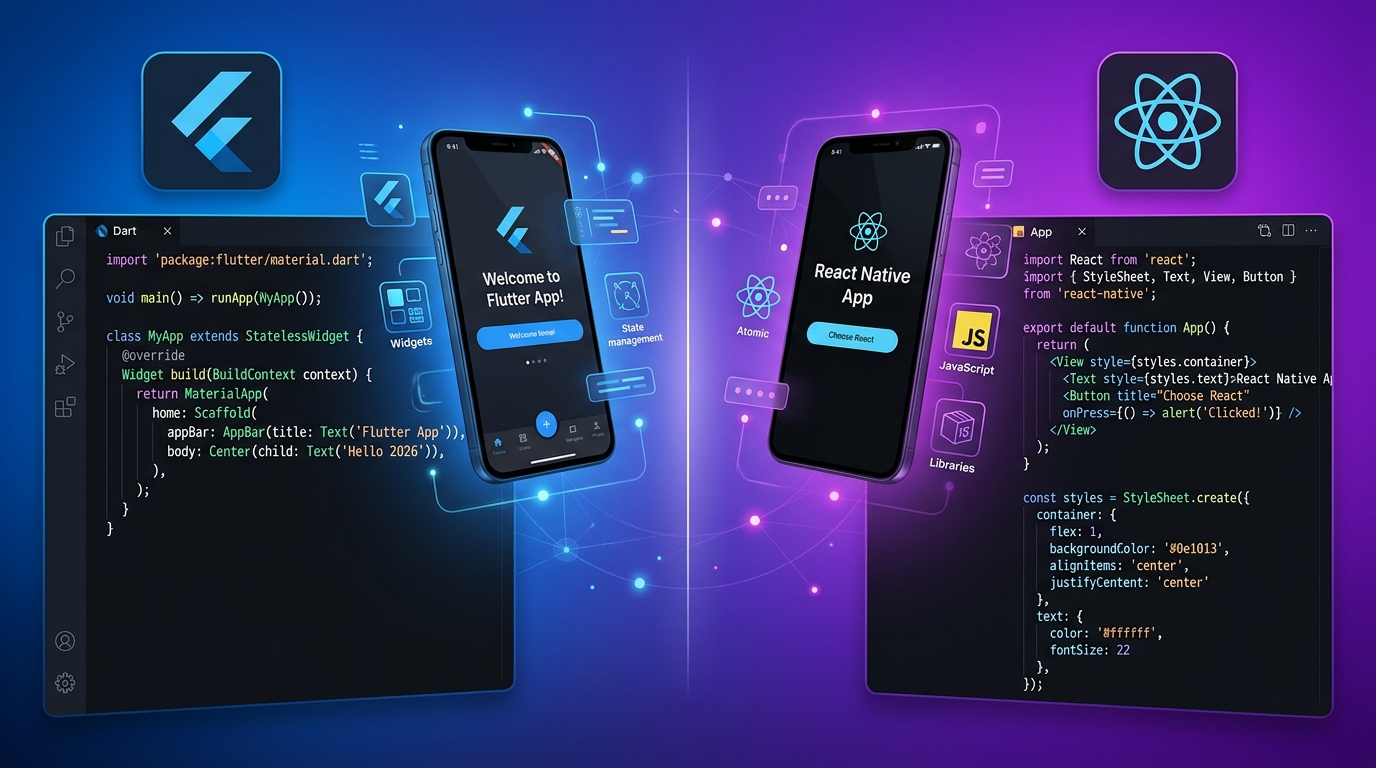
Almost every founder who asks us for a mobile app asks the same question in the first ten minutes: "Should we use Flutter or React Native?" Usually they've read three articles that disagree with each other, and a developer friend has told them one of the two is dead.
Neither is dead. Both are mature, both are actively maintained, and both can ship a polished iOS and Android app from one codebase. The honest answer is that the right choice depends less on the framework and more on your team, your product and what you plan to do after launch.
I'm Ruchit, and I run Axoryte Infosoft, a software development agency in Surat. We build with both. You should know my bias up front, though: most of the mobile work in our public portfolio is Flutter. I'll try to be fair anyway, and I'll tell you where React Native is the better call.
The short answer
If you only read one section, read this one:
- Pick Flutter if the app is the product, you want a custom, brand-heavy interface that looks identical on every phone, and nobody on your team is already deep in JavaScript.
- Pick React Native if you already have a React or Next.js web app, your team (or your future hires) live in TypeScript, and you want to share logic and people between web and mobile.
- Either is fine for most MVPs. A clear scope and a team that has shipped to the App Store and Play Store before matter far more than the logo on the framework.
What actually differs between them
You don't need to be technical to follow this. There are really only three differences that affect your business.
1. The language, and who you can hire
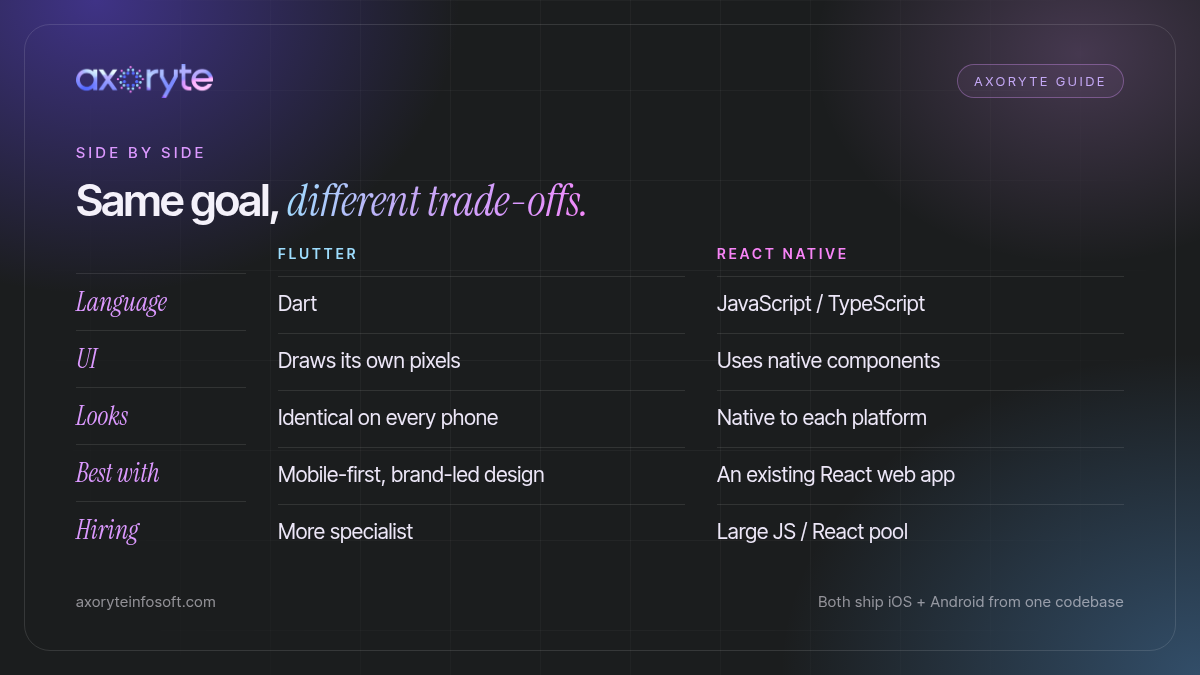
Flutter apps are written in Dart. React Native apps are written in JavaScript or, more often now, TypeScript. Dart is pleasant and easy to learn, but far fewer developers use it day to day than use JavaScript.
That matters most after launch. If you plan to hire your own engineers in a year, think about the hiring market where you are. A React developer can become productive in React Native fairly quickly. A Flutter developer is a more specific hire.
2. How the screens get drawn
This is the big technical difference, and it explains most of the other trade-offs.
- Flutter draws every pixel itself using its own rendering engine (Impeller is now the default on iOS and modern Android). Your app looks the same on an iPhone and a budget Android phone, because Flutter isn't asking the phone for its buttons.
- React Native uses the phone's own native components. A switch on iOS looks like an iOS switch. With the New Architecture, which is now the only architecture in current versions, the old performance complaints about the "bridge" are largely a thing of the past.
So Flutter gives you pixel-perfect control and consistency. React Native gives you a more platform-native feel by default. Neither is "better". It depends on whether your brand or the platform conventions should win.
3. The ecosystem around it
React Native sits inside the JavaScript world, so you get npm, a huge library ecosystem and Expo, which handles a lot of the painful build and release work. Flutter has its own package ecosystem on pub.dev, which is smaller but tends to be consistent, and a very complete set of built-in widgets.
In practice, both cover the usual needs: payments, maps, push notifications, camera, authentication and analytics. Where you'll feel the difference is with niche SDKs. Always check that the specific third-party service you depend on has a well-maintained package for your chosen framework before you commit.
When I'd pick Flutter
I lean towards Flutter when:
- The design is custom and brand-led, with animations, unusual layouts and a look that has to be identical on iOS and Android
- The app is mobile-first and there's no existing web codebase to share with
- The product leans on graphics, camera or real-time features where consistent rendering helps
- You want one small team to own the whole app without juggling platform-specific UI quirks
Two examples from our own work. MediConnect Telehealth is a HIPAA-compliant video consultation portal we built on Flutter with a NestJS backend and WebRTC for the calls. Genome AR Furniture lets people place furniture in their room with AR, built on Flutter with ARKit. Products like these need an interface that behaves the same on whatever phone the user happens to have.
When I'd pick React Native
React Native is the better call when:
- You already have a React or Next.js web app and want to share code, types and developers between web and mobile
- Your in-house team, or the team you plan to hire, already works in TypeScript
- You want the app to feel like a native iOS app on iPhones and a native Android app on Android, with platform-standard controls
- You want to lean on Expo's tooling for builds and over-the-air updates for small fixes
If you're a SaaS company whose web product is in React and the mobile app is a companion to it, I'd usually steer you here. One language across the whole product is a real long-term saving, even if it never shows up on the first quote.
Things that matter less than people think
A few arguments come up a lot that I don't give much weight to anymore:
- "X is faster." For a typical business app (forms, lists, dashboards, chat, video calls), both are fast enough that your users will never notice. Slow apps are almost always slow because of the backend, huge images or poor state management, not the framework.
- "Y is going to be abandoned." Flutter is backed by Google and React Native by Meta, and both have large communities and regular releases. Pick either and you're not betting the company.
- "We need fully native to be taken seriously." Plenty of serious products ship on cross-platform frameworks. Go fully native when you have a specific reason, like deep OS integration, heavy on-device processing, or separate iOS and Android teams you can afford.
Does the framework change the cost?
Less than you'd expect. Both let one team build iOS and Android from one codebase, which is the main saving compared with two native apps. What moves the price is scope: the number of screens, how custom the design is, integrations, offline support, real-time features and compliance work.
For reference, these are the typical ranges we publish on our site. They're starting points, not quotes, and your scope decides where you land:
- Mobile app MVP: typically $5,000 to $15,000
- Medium-complexity app (Flutter, iOS and Android): typically $15,000 to $50,000
- Complex apps: $50,000 and up
- Maintenance retainers: from $500 a month
Whoever you work with, ask for a range with the assumptions written next to it. If two quotes are far apart, it's usually because they've imagined two different apps.
A quick decision checklist
Run through these before you decide, ideally with whoever is going to build the app:
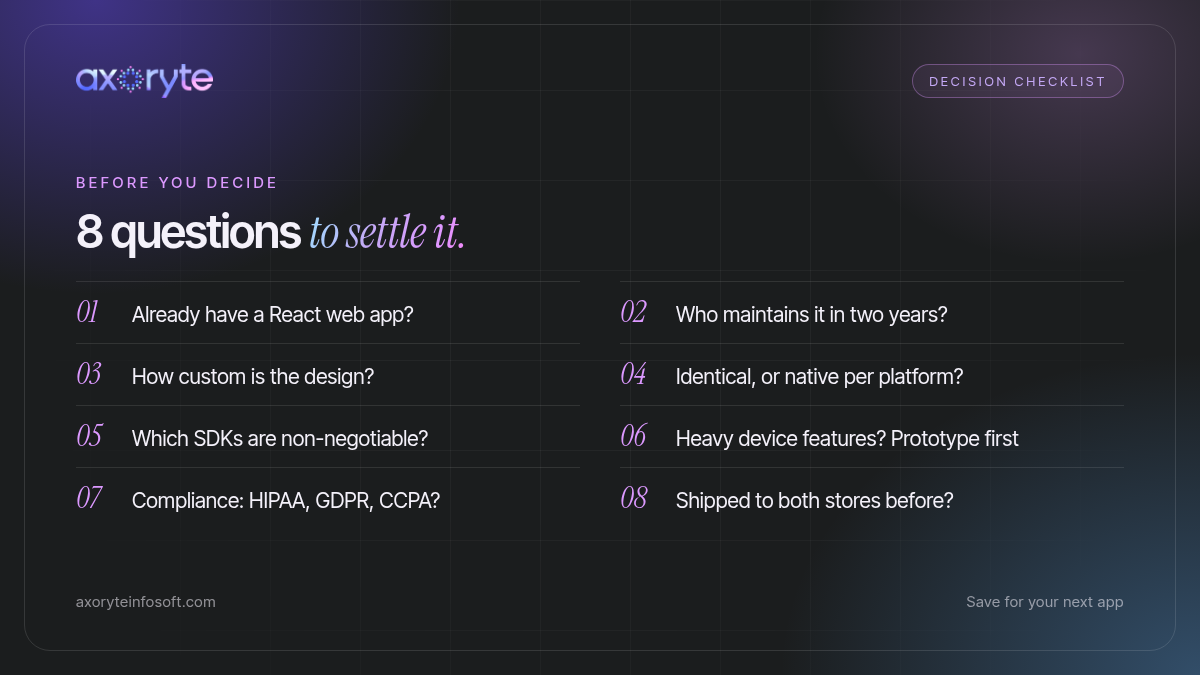
- Do we already have a React web app? If yes, React Native gets a strong head start.
- Who maintains this in two years? Check the hiring market for Dart vs TypeScript where you plan to hire.
- How custom is the design? The more brand-led and animated, the more Flutter makes sense.
- Should it look identical everywhere or feel native to each platform?
- Which third-party SDKs are non-negotiable? Confirm each has a maintained package for your framework.
- Any heavy device features? AR, Bluetooth, background location or video all deserve a quick proof of concept first.
- Compliance needs? HIPAA, GDPR or CCPA shape your backend and data handling far more than your framework choice.
- Has the team shipped this framework to both stores before? Ask to see live apps, not screenshots.
What I tell founders on the first call
If you're still unsure after all that, here's my honest default. With no existing web codebase and a design-heavy, mobile-first product, I'll usually suggest Flutter. With a React web app already live, or a team that thinks in TypeScript, I'll usually suggest React Native. And if a founder is torn, I'd rather spend a week building a small proof of concept of the riskiest screen than spend a month debating it.
Whichever you choose, the things that decide whether your app succeeds are the same: a tight MVP scope, a team you can actually see working, and a plan for what happens after the app is in the stores.
Want a second opinion on your app?
If you're a founder in the US, UK, Canada, Australia or the UAE deciding between Flutter and React Native, I'm happy to look at your idea and tell you which one I'd use and why, even if you build it with someone else. We sign an NDA before you share details, the discovery call is free, and you own 100% of the IP on delivery.
Send us your idea or book a 30-minute call.
FAQ
Is Flutter or React Native better for a startup MVP in 2026?
Both are good choices. Flutter suits mobile-first products with custom, brand-heavy design. React Native suits teams that already use React or TypeScript and want to share code and people with a web app.
Can one codebase really cover both iOS and Android?
Yes, for most business apps. You'll still need some platform-specific work for things like permissions, push notifications and store requirements, so budget a little time for each platform.
Can I switch frameworks later?
You can, but it's effectively a rewrite of the app's front end. Your backend and APIs carry over, which is one reason to keep business logic on the server where possible.
Does Axoryte build with both Flutter and React Native?
Yes. Both are part of our app development stack, alongside native iOS and Android. We'll recommend one based on your product and team, not on what we happen to prefer that week.