"How much will it cost?" is the first question almost every founder asks us, usually before they've told us what the app does. I understand why. You have a budget, maybe a pre-seed round or your own savings, and you need to know whether this idea is a $5,000 project or a $50,000 one before you get emotionally attached to it.
The frustrating truth is that most agencies won't give you a number until you've sat through two calls and signed an NDA. So I'm going to do the opposite here and put real ranges on the table, then explain exactly what pushes a project to the top or the bottom of them.
I'm Ruchit, and I run Axoryte Infosoft, a software development agency in Surat, India. We publish our price ranges on our website, so everything below matches what we'd actually quote you.
The short answer
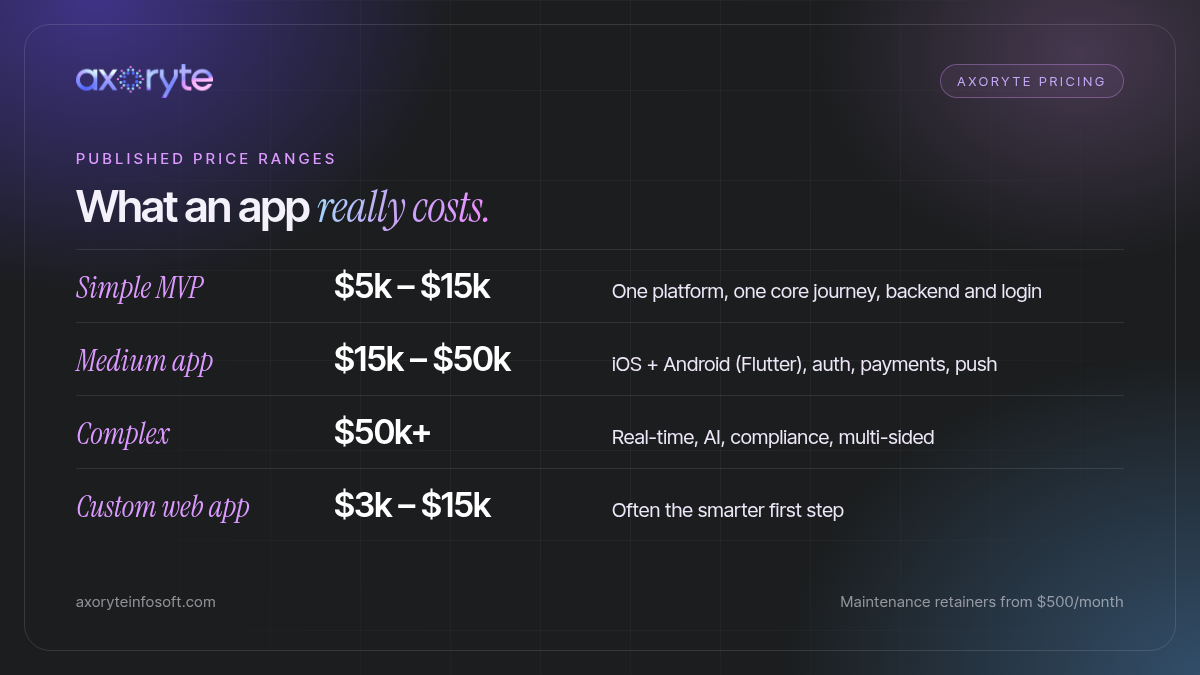
For a typical startup MVP built by an experienced offshore team, here's how the ranges on our app development page break down:
- Simple MVP app: $5,000 to $15,000. One platform (iOS or Android), one core user journey, the essential screens, a backend and login. Enough to put in front of real users and investors.
- Medium app (Flutter, iOS and Android): $15,000 to $50,000. Several user roles, payments, notifications, integrations, a proper design system and more polish.
- Complex product: $50,000 and up. Real-time features, AI or machine learning, heavy compliance, marketplaces with two sides, or anything with a lot of moving parts.
- Web app instead of a mobile app: $3,000 to $15,000 for a custom web app, which is often the smarter first step.
If an agency quotes you far below these ranges for a real product, ask what they're leaving out. If they quote far above them for an MVP, ask what you're paying for that your first hundred users will never see.
What an "MVP" should actually include
Most budget overruns start here, with a fuzzy idea of what "minimum" means. A minimum viable product is the smallest thing that proves people want what you're building. It is not version one of your full vision with a few features switched off.
A well-scoped MVP usually has:
- One core workflow that solves the main problem, done properly
- Sign-up and login
- A simple backend and database that can grow with you
- A basic admin panel so you can see and manage users without calling a developer
- Analytics, so you learn something from every user who tries it
What it usually doesn't need yet: social login with five providers, a referral system, dark mode, multi-language support, or an AI feature added because a competitor has one. All of those are good ideas for month four, once real users have told you what they want.
The 7 things that really drive the price
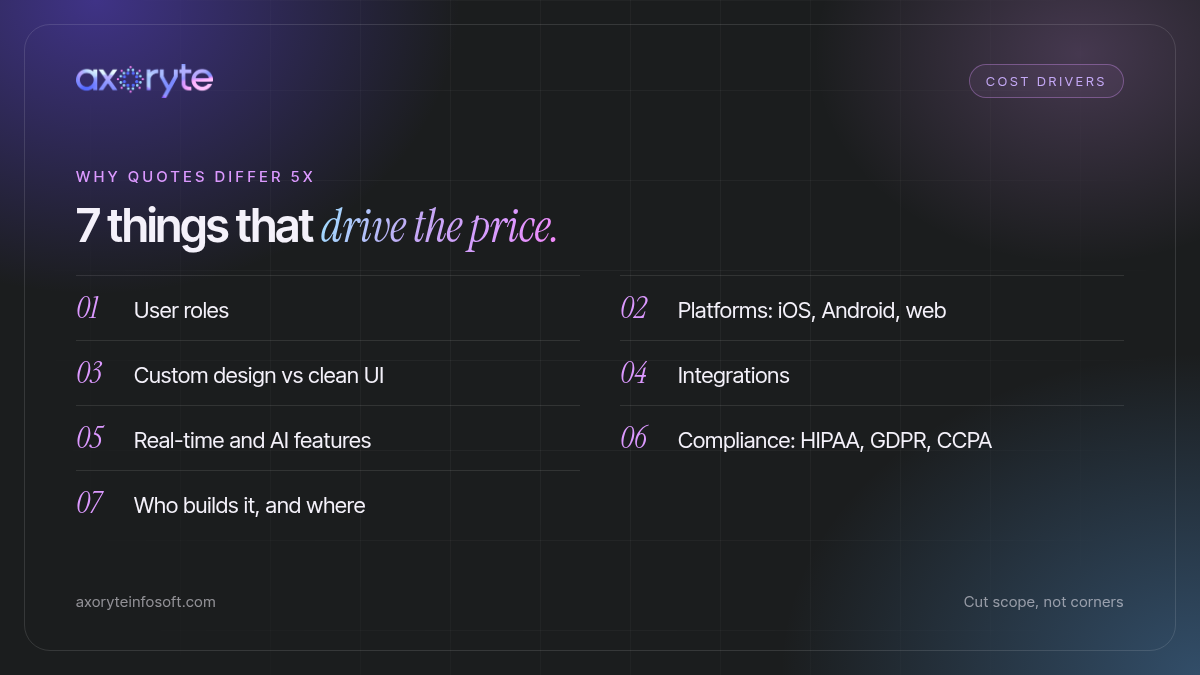
When two founders describe "an app like Uber for X," their quotes can differ by 5x. These are the reasons why.
1. The number of user roles
Every role (customer, provider, admin, manager) is almost a separate app with its own screens, permissions and edge cases. A one-role MVP is far cheaper than a two-sided marketplace. If you can launch with one side and handle the other manually for a while, you'll save a lot.
2. iOS, Android, web, or all three
Launching on one platform first is the cheapest way to validate an idea. When you need both, cross-platform frameworks like Flutter and React Native let one codebase ship to iOS and Android, which keeps the jump to the medium tier far smaller than building two native apps. Adding a full web app on top is extra work. (If you're stuck choosing, we wrote an honest Flutter vs React Native comparison.)
3. Custom design versus a clean standard UI
A polished, brand-heavy interface with custom animations takes more design and front-end time than a clean interface built from proven components. For an MVP, clear and fast beats beautiful and late.
4. Integrations
Payments, maps, calendars, CRMs, shipping providers, accounting tools. Each one is a dependency with its own quirks, documentation and test cases. Count them before you ask for a quote, because they add up quickly.
5. Real-time and AI features
Chat, live tracking, video calls and AI features (an LLM assistant, document search, recommendations) are where projects jump a tier. They're absolutely doable, and we build them, but they need more engineering and more testing, and AI features also add ongoing usage costs.
6. Compliance and security
If you handle health data (HIPAA), personal data of EU or California residents (GDPR, CCPA) or payments, the app needs more careful architecture, audit trails and testing. We built MediConnect, a HIPAA-compliant telehealth video consultation portal, and compliance shaped almost every technical decision on that project. Budget for it from day one; retrofitting it later costs more.
7. Who builds it, and where
Onshore agencies in the US, UK or Australia have higher hourly rates simply because salaries and costs are higher there. An experienced offshore team can build the same product for less. The catch is that "cheaper" only works if the team communicates well, works in your time zone for part of the day, and doesn't hand your project to subcontractors. We wrote a whole guide on how to hire an offshore MVP team without getting burned.
The costs nobody puts in the quote
The build is only part of the bill. Plan for these too:
- App store accounts. Apple's Developer Program is $99 a year. A Google Play developer account is a one-time $25.
- Store commission. If you sell digital goods or subscriptions inside the app, Apple and Google take a cut, typically 15% to 30%.
- Hosting and third-party services. Cloud servers, databases, email and SMS providers, maps and AI APIs. Often small at launch, but they grow with your users.
- Maintenance. Operating systems update every year, libraries change and bugs show up with real usage. Our maintenance retainers start at $500 a month, and every project we deliver includes 30 days of post-launch care.
- Your own time. Someone has to answer questions, test builds and make decisions every week. The fastest projects we've seen are the ones where the founder shows up to every demo.
Fixed price, time and materials, or a dedicated team?
How you pay changes what you get, so pick the model that fits where you are:
- Fixed scope and price works best for a tightly defined MVP. You know the cost up front, but changes mid-project need a change request.
- Agile time and materials suits products that will evolve as you learn. You pay for the work actually done and can change priorities every sprint.
- A dedicated team makes sense after launch, when you need ongoing development at a steady pace without hiring in-house yet.
Whichever model you choose, make sure the contract says you own 100% of the code and IP on delivery. At Axoryte, that's standard.
How to get a quote you can actually trust
You'll get a far more accurate number, from us or anyone else, if you bring these five things to the first call:
- The one problem your app solves, in a sentence.
- The core user journey, step by step, even if it's just bullet points.
- Must-have versus nice-to-have features, honestly separated.
- Every integration you know you'll need (payments, maps, CRM and so on).
- Your budget range and launch date. Sharing your budget doesn't mean you'll be overcharged. It lets a good team tell you what's realistic within it.
Then compare quotes on what's included, not just the total: design, testing, deployment to the app stores, documentation, post-launch support and who owns the code.
The bottom line
A real MVP doesn't have to cost a fortune. For most startups, a focused, well-built first version lands in the $5,000 to $15,000 range, and the biggest savings come from cutting scope, not cutting corners.
If you'd like a rough scope and estimate for your idea, get in touch and book a free discovery call. We'll sign an NDA before you share the details, and you'll leave the call with a realistic number, whether or not you build with us.
Ruchit Lukhi, Axoryte Infosoft, Surat, India