Think about how you last researched a supplier. There's a good chance you didn't open ten tabs. You typed a question into Google, read the AI answer at the top, maybe asked ChatGPT a follow-up, and clicked one or two of the links it gave you. Your buyers are doing the same thing when they look for a company like yours.
That's the shift. A growing share of buyers now get a written answer first and click second, and only a handful of websites get named or linked inside that answer. If yours isn't one of them, you can rank on page one and still be invisible at the moment someone decides who to call.
I'm Ruchit, and I run Axoryte Infosoft, a web and app development company in Surat, India, working with clients in the US, UK, Australia, Canada and the UAE. We build SEO and AI-search readiness into every site we ship, so this guide is the checklist we actually use, not theory.
What changed in Google AI Mode on 15 October 2026
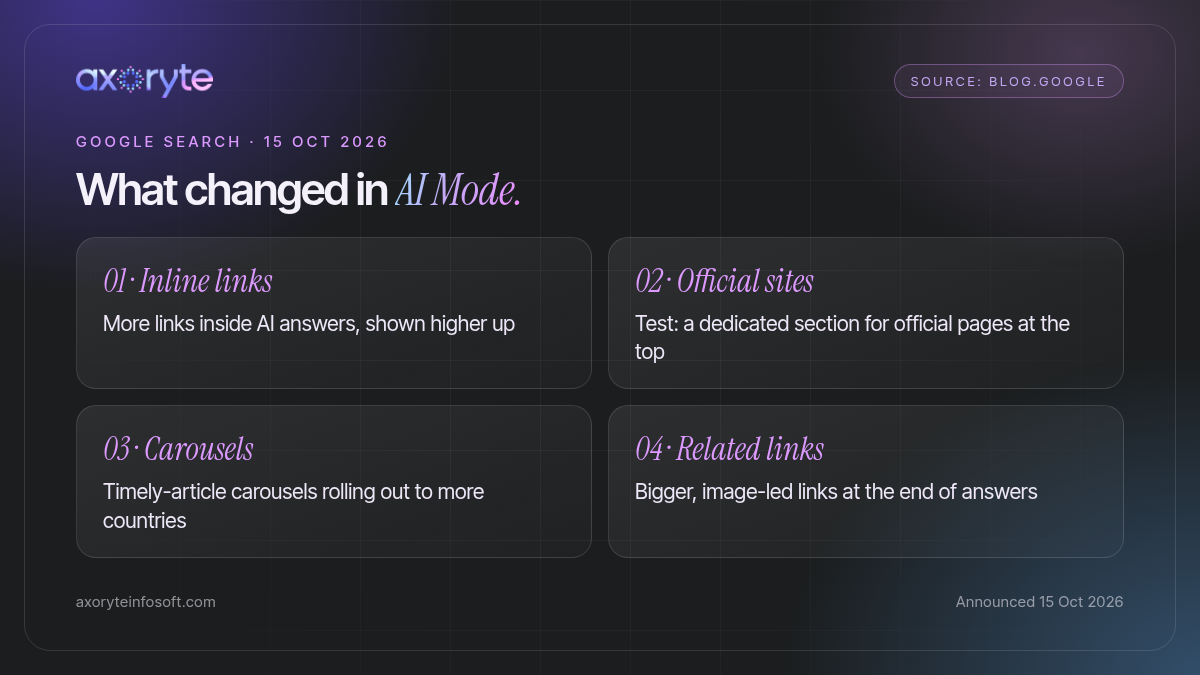
On 15 October, Google published "More ways to connect with the web from Search", a set of updates to AI Mode and AI Overviews. Four of them matter if you run a business website:
- More inline links, placed higher. Google says it has made "continued and substantial increases" to links embedded in the words of AI answers, and will show them higher up more often.
- A test of an official-sites section. For tasks where only one or two official pages can help, Google is testing a dedicated section at the top of the AI response, with context about why each link is useful.
- Bigger carousels for timely articles, rolling out to more locations and languages, with your Preferred Sources highlighted.
- More prominent related links at the end of answers, now with image thumbnails and a more clickable design.
Read together, the message is simple. AI answers are sending more clicks to specific pages, and Google wants those pages to be the clearest, most official source for the question. A vague homepage that tries to say everything is not that page. A focused page that answers one thing well is.
SEO, AEO, GEO: what are we actually optimizing for?
You'll see three labels. SEO is ranking in the classic blue links. AEO (answer engine optimization) is getting your content picked as the direct answer. GEO, generative engine optimization, is getting your brand mentioned, quoted or linked inside AI-generated answers from Google AI Mode, AI Overviews, ChatGPT, Perplexity and Gemini.
The good news is that they overlap almost completely. AI search tools still crawl and read the web. They favour pages that are fast, clearly structured, easy to quote and backed by consistent information about who you are. Good SEO is the foundation; GEO is about making that foundation easy for a machine to understand and cite.
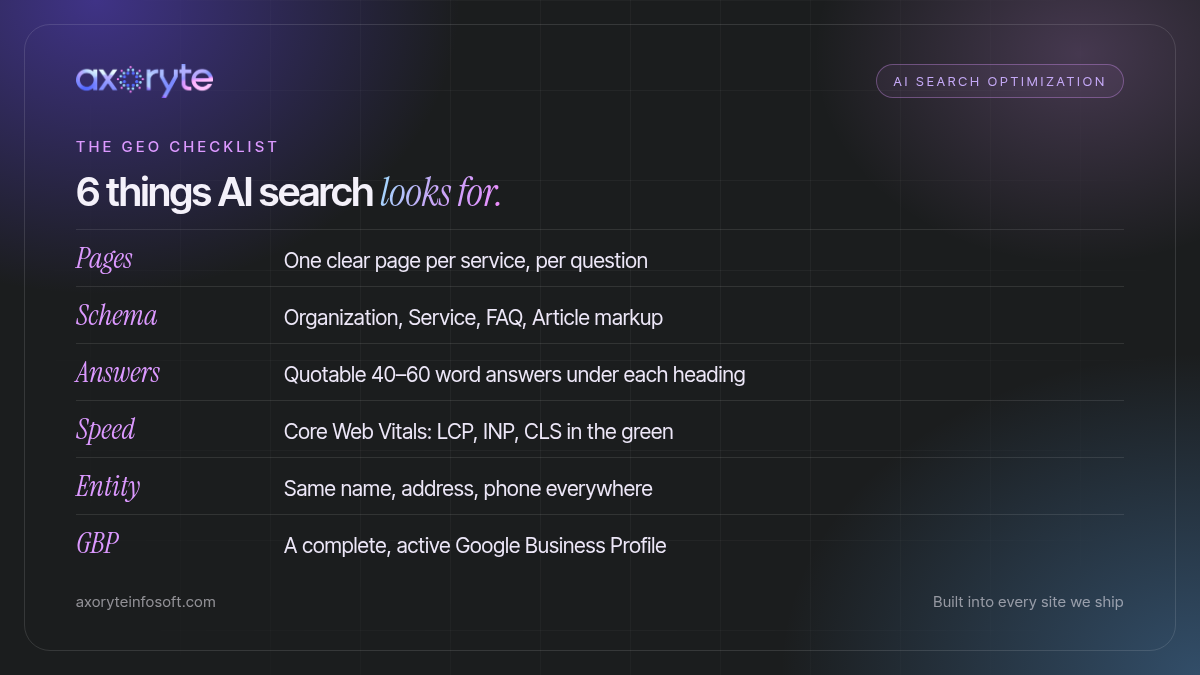
The 6-step checklist for AI search optimization
1. Give every service its own page
This is the step most small companies skip, and it's the one that matters most. If someone asks ChatGPT to "find a web development company in India that builds with Next.js", the AI looks for a page that clearly says exactly that. A homepage listing ten services in one paragraph rarely wins.
Build one page per service, and where it makes sense, one page per market you serve. Each page should say in its first two sentences what you do, who it's for and where you work. Then cover the details buyers ask about: the process, tech stack, timelines, pricing ranges if you publish them, and real examples. For instance, our web development page and app development page each stand alone and list our published price ranges, because "how much does it cost" is one of the first things people ask an AI.
2. Add schema markup (structured data)
Schema is a small block of JSON-LD code that tells search engines, in a fixed vocabulary, what a page is about. It doesn't guarantee anything, but it removes guesswork. The types worth adding on a services business site:
- Organization (or LocalBusiness) on the homepage: legal name, logo, address, phone, and sameAs links to your LinkedIn, Instagram and other official profiles.
- Service on each service page, with the service name, description and the areas you serve.
- Article on blog posts, with a real author name and publish date.
- FAQPage where you have a genuine question-and-answer section.
- BreadcrumbList so the structure of your site is obvious.
Test every page in Google's Rich Results Test before you publish. Broken schema is worse than none, because it tells the crawler your data can't be trusted.
3. Write quotable answers, not marketing copy
AI tools quote sentences that stand on their own. "We are passionate about delivering innovative solutions" can't be quoted because it says nothing. "A custom web app typically costs $3,000 to $15,000 with us, depending on user roles and integrations" can be quoted, because it answers a question.
A pattern that works well: put a real question as the heading (the way a buyer would type it), then answer it directly in the first 40 to 60 words underneath. Add detail, examples and caveats after that. Add a short FAQ block near the bottom of each service page with the five or six questions your sales calls actually start with. If you don't know what those are, check your inbox. Your prospects have already written them down for you.
Two more habits help. Name things precisely (say "Flutter app for iOS and Android", not "cross-platform solutions"). And show who wrote the page. A named author with a real profile is easier to trust than "Admin".
4. Make the site fast (Core Web Vitals)
Google AI Mode now sends people to specific pages more often, so the page they land on has to load quickly or they leave. Google's Core Web Vitals give you three targets to hit on real users' devices:
- LCP (Largest Contentful Paint): the main content visible in 2.5 seconds or less.
- INP (Interaction to Next Paint): the page responds to taps and clicks in 200 milliseconds or less.
- CLS (Cumulative Layout Shift): 0.1 or less, so nothing jumps around while it loads.
Most slow business sites have the same few problems: oversized images, too many third-party scripts and chat widgets, and page builders that ship far more code than the page needs. Server-side rendering with a framework like Next.js, compressed modern image formats and a CDN fix most of it. Check your numbers in PageSpeed Insights and the Core Web Vitals report in Search Console, not just on your own fast laptop.
Also check the boring basics: your pages are indexable, your sitemap is submitted, and your robots.txt doesn't block the crawlers you want. If you want to appear in ChatGPT search, don't block OpenAI's OAI-SearchBot. And verify your site in Bing Webmaster Tools too, since several AI assistants draw on more than one search index.
5. Keep your business information identical everywhere
AI systems build a picture of your company from many sources: your website, your Google Business Profile, LinkedIn, directories like Clutch, and anything else that mentions you. When your company name, address, phone number, services and founding year match everywhere, that picture is clear. When one profile says you serve 15 countries and another says 50, the AI has a reason to hesitate, and so does a buyer.
Spend an afternoon on this. List every place your business appears, fix the mismatches, and link your official profiles from your site's footer and Organization schema. It costs nothing and it's one of the highest-return jobs on this list.
6. Treat your Google Business Profile as a real channel
Your Google Business Profile feeds Maps, local results and Google's understanding of your business, even if most of your clients are overseas. Fill in every field: categories, a description that says plainly what you do and who for, each service listed as a product with its own description and link, real photos, and opening hours. Post updates regularly and reply to every review. An active, complete profile is one more consistent, official signal that you are who your website says you are.
What not to waste time on
- Writing for robots. Keyword-stuffed pages read badly to people and to AI. Write the way you'd explain it on a call.
- Mass-producing thin AI articles. Fifty near-identical posts won't make you the answer. One genuinely useful page will do more.
- Claims you can't back up. If an AI or a buyer finds a number on your site that doesn't hold up, you lose trust you won't easily win back. Publish what's true and specific.
Frequently asked questions
What is generative engine optimization (GEO)?
Generative engine optimization is the work of making your website easy for AI search tools such as Google AI Mode, AI Overviews and ChatGPT to understand, trust and cite. In practice it means focused service pages, structured data, clear quotable answers, fast pages and consistent business information across the web.
Is GEO different from SEO?
Mostly no. GEO builds on SEO rather than replacing it. AI search still relies on crawling and ranking web pages, so technical SEO, good content and site speed remain the base. GEO adds a focus on clear answers, structured data and brand consistency so AI tools can quote you accurately.
How long does it take to show up in AI answers?
There's no fixed timeline, and nobody can guarantee placement. Technical fixes like schema, speed and indexing can be done in a few weeks. Being cited depends on Google and other AI tools recrawling your pages and on how well your content answers real questions compared to other sites.
Do I need a new website for AI search optimization?
Not always. If your current site is reasonably fast and built on a modern stack, adding service pages, schema and FAQ content is often enough. A rebuild makes sense when the site is slow, hard to edit or can't support clean page structure and structured data.
Can an offshore web development company handle SEO-friendly website development?
Yes, if SEO is part of the build rather than an afterthought. Ask any team, in India or anywhere else, to show you their approach to schema, Core Web Vitals and page structure before you hire them. At Axoryte, SEO and AI-search readiness are included in every website we build.
The bottom line
Google's 15 October update points one way: AI answers are linking out more, and they're choosing clear, official, well-built pages to link to. You don't need tricks to be one of them. You need a page for each thing you sell, answers people can quote, structured data, a fast site and the same facts about your business everywhere.
If you'd like us to look at your site and tell you what's stopping it from showing up in AI search, book a free 30-minute call. Whether you need a few fixes or want to hire web developers in India for a full SEO-friendly rebuild, you'll leave with a clear list of next steps. You can also see our work at axoryteinfosoft.com.
Ruchit Lukhi, Axoryte Infosoft, Surat, India